PostHeaderIcon Magnitude 7.4 quake strikes in sea off Tonga -USGS

A magnitude 7.4 earthquake struck in the sea 177 (285 km) miles southwest of Tonga’s capital Nuku’alofa, the U.S. Geological Survey reported on Thursday.

It said the quake was recorded at a depth of 106 miles and had struck at 1719 GMT.

The Pacific Tsunami Warning Center on its website said that no “destructive Pacific-wide tsunami” was expected.

English: Tsunami hazard sign

Enhanced by Zemanta

PostHeaderIcon GPS Could Issue Tsunami Alert in Minutes

Still from an animation show how seafloor features influenced the March 11 japan tsunami.
An image from an animation using satellite observations of the March 11 tsunami that shows how the waves of the tsunami were influenced by seafloor features. Wave peaks appear in red-brown, depressions in blue-green and ocean floor topography is outlined in gray.
CREDIT: NASA/Jesse Allen, using data provided by Tony Song (NASA/JPL)

The global positioning system (GPS) — the same system that helps people navigate unfamiliar places — could also serve as an early-warning system for tsunamis, according to new research.

When a magnitude-9.0 earthquake struck Japan on March 11, 2011, coastal residents received an inaccurate estimate of the earthquake’s magnitude before the waves hit and leveled thousands of buildings.

The area under alert was warned based on an estimatedearthquake magnitude of 7.9 — 130 times less intense than the actual quake was — meaning fewer neighborhoods were evacuated in response to the perceived threat.


Researchers behind a new study have said that GPS systems along the coast could have given the residents a better warning. Sifting through the GPS data from stations along the coast and issuing a more accurate tsunami alert based on that data would only have taken three minutes, the study found. [7 Ways the Earth Changes in the Blink of an Eye]

Subduction zones and GPS

Most tsunamis occur when one tectonic plate slides underneath another and causes an earthquake. In the process, the top plate is forced upward, and this uplift of the seafloor pushes on the water above it, setting off the tsunami. How high the ground rose on the seafloor would influence wave heights up on the surface.

The coast also slightly rises or falls along with the ocean floor, making it possible to see these changes through coastal GPS stations. Therefore, areas near these so-called subduction zones can be mapped and measured using GPS to see how much the ground has shifted and in what way it has deformed.

Whereas traditional seismological stations are located some distance away from the source, GPS transmitters can be placed much closer, on the coastline, to where the tsunami occurred, buying valuable time for those looking to escape.

“To really get absolute values of slip, you would need to have stations at the seafloor,” said Andreas Hoechner, a postdoctoral researcher at the GFZ German Research Centre for Geosciences in Potsdam.

“However, [the coastal GPS readings are] good enough to get good tsunami wave estimates.”

A subduction quake makes several ocean waves: crest waves on top of the seafloor that rise, and trough waves on the seafloor that drop down. Additionally, independent research has recently showed that a shoreline’s features also influence the severity of a tsunami’s impact on land.

Reconstructing an alert

To reconstruct what a GPS alert would have looked like during the 2011 temblor, the scientists took information from the Japanese GPS Earth Observation Network (GEONET)the day before, the day of, and the day after the 2011 earthquake. The station is typically used for long-term changes to the ground, such as “relaxation processes” between earthquakes, but has not been applied yet for tsunami warnings, Hoechner said.

While Japan has about 1,200 of these stations, the researchers only used 50 of them in order to take less time to issue an alert. The exact number of stations does not matter in this scenario, Hoechner noted, as long as there are enough to note a rapidly changing height difference between the ground on the coast and the ground further inland.

GPS stations provide more accurate information about ground shifts than seismological stations do, as seismological stations are better suited for looking at the amount of ground shaking — rather than shifting — associated with an earthquake. Both systems are useful in their own ways and should be used together, Hoechner said.

In the case of Japan’s Tōhoku earthquake, a tsunami warning issued just three minutes after the earthquake struck would have provided several minutes for people to scramble to safety. Tsunamis typically hit land about 20 to 30 minutes after they are generated, Hoechner said, depending on the distance between land and the earthquake’s epicenter.

The challenge will be to actually use the GPS sensors for real events, not just for simulating past tsunamis. And the technique could be used not only in Japan, but also in Indonesia. After the devastating 2004 earthquake in that region, there were some GPS stations installed, but the researchers say more are needed to make accurate tsunami warnings.

The results appear in the latest edition of Natural Hazards and Earth System Sciences, an open-access journal of the European Geosciences Union.

Hoechner’s team plans to extend its research to Chile, which was the site of a devastating tsunami in 2010.

credit

Enhanced by Zemanta

PostHeaderIcon Government licensed secret buzzard egg destruction, documents reveal

Government licensed secret buzzard egg destruction, documents reveal

Eggs and nests of protected raptors destroyed to protect pheasant shoot, according to FoI documents

shoot, according to FoI documents

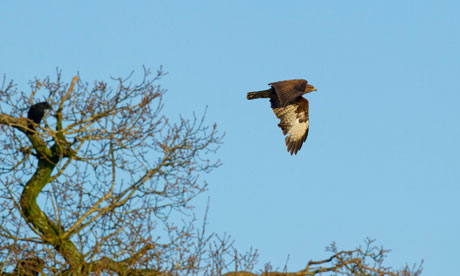
Buzzard in flight in Bedfordshire

Raptors gained legal protection decades ago. This is the first time since that action has been licensed against any bird of prey to protect game shoots. Photograph: Ben Hall/RSPB

A government agency has licensed the secret destruction of the eggs and nests of buzzards to protect a pheasant shoot, according to documents released under the Freedom of Information Act.

The action sets a historic precedent, being the first time such action has been licensed against any bird of prey to protect game shoots since raptors gained legal protection decades ago. Buzzards are recovering from near extinction and now number 40,000 breeding pairs, while 35m pheasants are bred each year for shoots.

It is also less than a year after the wildlife minister, Richard Benyon,abandoned related plans citing “public concerns”. Benyon, whose family estate in Berkshire runs shoots, cancelled plans to spend £375,000 on testing control measures for buzzards around pheasant shoots after a public outcry in May 2012. “I will collaborate with all the organisations that have an interest in this issue and will bring forward new proposals,” he said at the time.

The destruction of the nests, which took place in the last few weeks, was only revealed after the event through a freedom of information request by the RSPB.
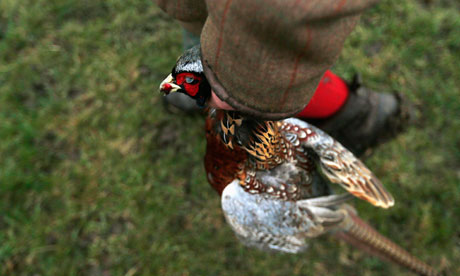
Shooting pheasants : A man holds a dead pheasant which he shot during in Lewknor, southern EnglandA man holds a dead pheasant shot during a pheasant hunt in Lewknor, England. Photograph: Eddie Keogh/Reuters”We were proceeding collaboratively and that is why we are so angry now,” said Martin Harper, the RSPB’s conservation director. “Most people would prefer to see buzzards soaring in the sky. They are big, majestic creatures in the wild and we don’t have many of them in the UK: they are England’s eagle. The fact the licence process takes place without public scrutiny is wrong.”

The licences were issued by the government’s licensing body, Natural England (NE) and permitted destruction of up to four nests and the eggs they held. “The law allows action to be taken against protected species to protect livestock, which includes any animal kept for the provision or improvement of shooting,” said a spokesman for NE. “We rigorously assessed the application [and] were satisfied the case met the criteria.”

The locations of the destroyed nests were not made public. NE stated the issue was “emotive and sensitive” and cited “public safety”. NE issued the licences despite its own expert reviewer stating: “There is no body of published evidence demonstrating that the presence of buzzards is likely to result in serious damage to a game shoot.” A related application to kill sparrowhawks was rejected.

The National Gamekeepers Organisation (NGO) was closely involved in winning the licences and had threatened NE with judicial review if they were not granted. “We believe the long-standing licensing process was correctly used in this case,” said a spokesman. “A few buzzards had been consistently killing a large number of pheasants. Most birds of prey are now at or near record levels in the UK, so conflicts with game management and farming are bound to occur from time to time.”

Pheasants are not native to the UK and were introduced to stock shoots, but the biomass of the population makes it now the single biggest bird species in the countryside. The growing popularity of shoots in the Victorian era saw buzzards poisoned, shot and trapped until just 1,000 pairs were left, but protection in recent decades has led to a partial recovery.

Jeff Knott, the RSPB’s bird of prey expert, said: “The buzzard has full legal protection, so why are we undermining this when all the available evidence shows they are not a significant source of loss of pheasant chicks.” An independent study commissioned by the British Association for Shooting and Conservation found that, on average, 1-2% of pheasant poults released were taken by all birds of prey, Knott said, adding that a third of all pheasants are killed on the roads. The NGO spokesman said the buzzard control project was cancelled last year after the RSPB’s campaign would have provided evidence of predation: “They can’t have it both ways.”

A spokeswoman for the Department of Environment, Food and Rural Affairs, said: “After a thorough assessment, Natural England granted a licence for the removal of a small number of buzzard nests. Buzzard populations are thriving in the UK and this licensed action had no effect on their population.”

Labour’s environment secretary, Mary Creagh, said buzzards had recovered under the previous government: “This latest revelation blasts a hole in ministers’ empty words about protecting Britain’s iconic native species. It is astounding the government has granted licences after ministers were forced to U-turn last year.” She also criticised Benyon: “Who exactly do ministers think they are there to serve? ”

A key criteria for the granting of the licences was that all non-lethal control methods, such as creating places for pheasants to hide and diverting buzzards away by leaving food out, had been unsuccessfully tried. But the NE expert who reviewed the application reported: “Overall, there is a pattern of [non-lethal] methods being employed inconsistently.” The reviewer also noted that “the efficacy of [nest and egg destruction] is untested”. Harper said the RSPB was considering its legal options.

The government has previously been criticised for favouring grouse shooting in the Pennines, after NE abandoned plans to ban the burning of peat land on a grouse moor and withdrew from a related legal action against the Walshaw Moor estate.

credit

Enhanced by Zemanta

PostHeaderIcon Woolwich: ‘Soldier Dead After Terror Attack’

Woolwich

A man reported to be a serving soldier has been hacked to death in Woolwich, south east London, in what is being treated as a terrorist attack.

Dozens of weapons – including a number of knives – and pools of blood could be seen on the ground in John Wilson Street, where a man said to be wearing a Help for Heroes T-shirt was attacked by two men.

Witnesses say the pair appeared to deliberately drive their car at the victim, before getting out with various bladed weapons and launching their attack.

Woolwich (Credit: ITV)
An image of one of the alleged attackers (pic: ITV)

As the victim lay motionless in the middle of the road, witnesses say they heard the pair chanting “Allahu akbar” – and inviting passers-by to take photographs of them.

As soon as armed police arrived at the scene, witnesses say at least one of the alleged attackers began approaching the officers – who opened fire and shot the pair. The men were taken to separate hospitals with gunshot wounds.

Prime Minister David Cameron described the incident as “shocking and horrifying” and said there were “strong indications that it is a terrorist incident”.

Woolwich
The incident happened around a mile from the Royal Artillery Barracks

He told a news conference in Paris that Britain had previously faced terror attacks such as the one in Woolwich, adding: “We will never buckle in the face of it.”

He has cut short a trip to Paris and arrived back in London to attend a Thursday morning meeting of the Government’s Cobra emergency committee – which had convened in the hours after the incident on Wednesday afternoon.

Woolwich street attack
Members of the public surrounded the scene of the attack

Video has emerged that appears to show one of two alleged attackers – with blood-stained hands and holding two bladed weapons – attempting to justify the attack.

“I apologise that women had to witness this today, but in our lands our women have to see the same,” he said.

Photographs taken at the scene show three people lying on the ground. Their condition was not clear. A car that appeared to have crashed on the pavement could also be seen.

Officials wearing full army uniform were seen entering Plumstead Police Station this evening and confirmed they were there in connection with the case.

Woolwich street attack
Scores of police were sent to John Wilson Street

The Metropolitan Police confirmed one person had died following the incident and said officers from the counter terrorist unit were leading the investigation

The Independent Police Complaints Commission will also investigate the police’s role in the incident, which is standard practice in cases where armed police fire their weapons.

Met commissioner Sir Bernard Hogan-Howe, said:  ”On the streets of London, a terrible murder has occurred.

“We ask that people give us the opportunity to thoroughly investigate this crime, to make sure we get to the bottom of who committed it and why.”

Woolwich
An aerial shot of the scene

Commander Simon Letchford, also from the Met, said officers were called to the road at 2.20pm.

“One man was being assaulted by two other men,” he said.

“A number of weapons were reportedly being used in the attack, and this included reports of a firearm.

“Officers including local Greenwich officers arrived at the scene and shortly after firearms officers arrived on the scene.

Woolwich street attack
An Air Ambulance helicopter was scrambled to the attack

“On their arrival at the scene they found a man, who was later pronounced dead.  At this early stage I am unable to provide any further information about the man who has died.

“Two men, who we believe from early reports to have been carrying weapons, were shot by police. They were taken to separate London hospitals, they are receiving treatment for their injuries.”

Nigel Foran, who saw the incident as he returned home from shopping, described a scene of confusion.

He told Sky News: “We saw a man running towards the police officers and then we heard a couple of gunshots.

David Cameron and Francois Hollande give their reaction to the attack in Woolwich
David Cameron at a news conference in Paris

“He went to the floor and was surrounded while officers drew their stun guns. After that, all the people who were watching ran away when they heard the gunshots.”

The Ministry of Defence said it was urgently looking at the reports that the incident involved a soldier.

Greenwich and Woolwich MP Nick Raynsford had earlier told Sky News he believed the deceased was a serving soldier.

He said he had spoken to both borough commander Richard Wood and Lieutenant Colonel Bob Christopher at  Royal Artillery Barracks  – which is around a mile from the scene of the attack.

“We think a serving soldier was the victim. We don’t know the circumstances surrounding the incident.”

Help for Heroes, the charity whose t-shirt witnesses said the victim was wearing, said: “Help for Heroes is appalled to hear that a man, believed to be a serving soldier, has been brutally murdered in Woolwich today.

“We are desperately saddened to hear of this sickening attack and offer our thoughts and prayers to his family, colleagues and friends.”

Schools in the area were placed on lockdown.

Mayor of London Boris Johnson posted on his Twitter account: “This afternoon’s attack in Woolwich is a sickening deluded and unforgivable act of violence.”

:: Police have issued an appeal for anyone who has still or moving images of the incident to send them to: woolwich@metincident.co.uk

credit

Enhanced by Zemanta

PostHeaderIcon Obama administration supports fracking and natural gas exports

Obama administration initiatives last week support hydraulic fracturing and natural gas exports, despite environmental opposition.

Last Thursday, the US Department of the Interior released a draft proposal that would “establish common-sense safety standards for hydraulic fracturing on public and Indian lands.” Last Friday, the US Department of Energy (DOE) approved a Liquefied Natural Gas (LNG) terminal in Freeport, Texas.

Despite opposition from environmental groups, the Obama administration apparently supports the expansion of the natural gas industry and the controversial technology of hydraulic fracturing. These events are welcome common sense from an administration that is typically deep in green ideology.

Good old Yankee ingenuity has produced a new hydrocarbon revolution. Vast quantities of oil and natural gas can now be recovered from shale rock formations, thanks to enabling technologies of hydraulic fracturing (or fracking) and horizontal drilling.

US crude oil production in 2012 was up 30 percent since reaching a low in 2008. Natural gas production is up 33 percent since 2005. Bob Dudley, CEO of BP, forecasts that the United States will be “nearly self-sufficient in energy” by the year 2030.

Fracking is not new, but has been perfected over the last 20 years to allow cost-effective recovery of hydrocarbon fuels from shale. Water and sand, along with a small amount of chemicals, are injected under pressure to fracture the shale and create millions of tiny fissures, releasing the trapped gas or oil. To develop a large producing field, horizontal drilling is used to bore mile-long horizontal shafts into the shale. Fracking is typically used at depths greater than 5,000 feet.

Hydraulic fracturing is under assault from environmental organizations. According to the Sierra Club, “Fracking, a violent process that dislodges gas deposits from shale rock formations, is known to contaminate drinking water, pollute the air, and cause earthquakes.” A 2011 letter from Friends of the Earth, Greenpeace USA, Climate Protection Campaign, and other groups urged President Obama to “halt hydraulic fracturing…until and unless the environmental and health impacts of this process are well understood and the public is adequately protected.”

The draft rule released Thursday from the Department of the Interior acknowledges that hydraulic fracturing can be conducted in an environmentally safe manner. It calls for disclosure of chemicals used in fracking, assurances of well-bore integrity to prevent leakage of gas and fluid into ground water supplies, and confirmation of a water management plan for disposal of water and fluids used in the fracking process.  Indeed, fracking has been used more than 500,000 times over the last 50 years without incidents of water contamination when proper safeguards were employed.

The hydrofracturing revolution has created a glut of natural gas in the US market. Prior to wide-scale use of fracking, natural gas prices reached $15 per million British thermal units (Btu), and port facilities were being constructed to import LNG. By 2011, prices had fallen to $4 per million Btu and import terminals sat idle.

Unlike crude oil, which is priced and sold in a global market, natural gas is priced and sold regionally. To date, the fracking revolution has been a US phenomenon, with other nations slow to join. While US gas prices have dropped to under $4 per million Btu, Europe’s prices remain above $10, and the price of imported LNG in Japan is above $15.

US producers now see an opportunity to liquefy the gas and ship it to Europe and Japan. Twenty applications have been filed with the Department of Energy (DOE). The approval last week of the Freeport export terminal in Texas is the first since 2011. The $10 billion terminal plans to export up to 1.4 billion cubic feet of natural gas per day, or about two percent of annual US consumption.

Environmental groups have criticized the approval. “Exporting LNG will lead to more drilling―and more drilling means more fracking, more air and water pollution, and more climate fueled weather disasters like last year’s record fires, droughts, and superstorms,” according to Deb Nardone of the Sierra Club. Nevertheless, it appears that the Obama administration will support hydraulic fracturing and the growth of the natural gas industry.

Shale gas booms in Texas, Louisiana, and Pennsylvania have created tens of thousands of jobs. Low natural gas prices are attracting global chemical firms to build plants in the US. Thousands of additional jobs and tax revenues can come from LNG exports. Sound energy policy demands that fracking and export of natural gas be allowed, if environmental safeguards are met.

credit

Enhanced by Zemanta

PostHeaderIcon M3.2 Solar Flare

M3.2 Solar Flare
A moderate solar flare reaching M3.2 was detected around Sunspot 1748 at 08:57 UTC Friday morning. The latest solar flare event was associated with a 10cm Radio Burst (TenFlare) measuring 450sfu, along with Type II and IV Radio Emissions (Sweep Frequency Events). The active region is now in a geoeffective position for Earth directed Coronal Mass Ejecitons. I will provide further updates should a CME be associated. Stay Tuned for more information. Image below by SDO.


Enhanced by Zemanta

PostHeaderIcon Deadly tornado strikes Texas town of Granbury

A tornado has ripped through a town in the US state of Texas, resulting in six deaths, officials say.

Homes were destroyed when the tornado hit Granbury, 70 miles (110km) west of Dallas, late on Wednesday.

Hood County Sheriff Roger Deeds warned the death toll could rise as rescue teams search the area. Several people are being treated for injuries at local hospitals.

The tornado was one of three to hit northern Texas on Wednesday night.

A tornado near Seymour, Texas

One Granbury resident described the tornado’s impact to Reuters: “The house started shaking. We were in a closet.

“You could hear it – it sounded like a train going off. It was scary,” he said.

Officials report the tornado caused multiple fatalities as it tore through Granbury

Sheriff Deeds said he hoped the number of dead would remain at six, as officials awaited daybreak.

“I’ve been assured by my deputies on the scene that they’re pretty confident with the six that they found, but there was a report that two of these people that they found were not even near their homes. So we’re going to have to search the area out there,” he told AP.

The hardest hit neighbourhoods were Rancho Brazos Estates and DeCordova Ranch, in the southern part of Granbury.

“I saw the top of a house pulled off, with lots of debris all over the place,” eyewitness Jeff Mangum told the BBC. “The whole sky was spinning in a thousand directions.”

Tornado swarm

The same storm spawned another tornado that tore through part of the town of Cleburne, about 25 miles (40km) south-east of Granbury, the National Weather Service said.

There have been no reports of any fatalities from Cleburne so far.

However, dozens of homes have been destroyed or badly damaged, according to officials and residents.

A third tornado in neighbouring Parker County has also caused damage to buildings, particularly in the town of Millsap, officials say.

Enhanced by Zemanta

PostHeaderIcon Life on Mars to become a reality in 2023, Dutch firm claims

Thousands apply to become one of four astronauts selected to set up a human colony in a plan that comes with snags

Mars, 2001, with the southern polar ice cap vi...

A few months before he died, Carl Sagan recorded a message of hope to would-be Mars explorers, telling them: “Whatever the reason you’re on Mars is, I’m glad you’re there. And I wish I was with you.”

On Monday, 17 years after the pioneering astronomer set out his hopeful vision of the future in 1996, a company from the Netherlands is proposing to turn Sagan’s dreams of reaching Mars into reality. The company, Mars One, plans to send four astronauts on a trip to the Red Planet to set up a human colony in 2023. But there are a couple of serious snags.

Firstly, when on Mars their bodies will have to adapt to surface gravity that is 38% of that on Earth. It is thought that this would cause such a total physiological change in their bone density, muscle strength and circulation that voyagers would no longer be able to survive in Earth’s conditions. Secondly, and directly related to the first, they will have to say goodbye to all their family and friends, as the deal doesn’t include a return ticket.

The Mars One website states that a return “cannot be anticipated nor expected”. To return, they would need a fully assembled and fuelled rocket capable of escaping the gravitational field of Mars, on-board life support systems capable of up to a seven-month voyage and the capacity either to dock with a space station orbiting Earth or perform a safe re-entry and landing.

“Not one of these is a small endeavour” the site notes, requiring “substantial technical capacity, weight and cost”.

Nevertheless, the project has already had 10,000 applicants, according to the company’s medical director, Norbert Kraft. When the official search is launched on Monday at the Hotel Pennsylvania in New York, they expect tens of thousands more hopefuls to put their names forward.

Kraft told the Guardian that the applicants so far ranged in age from 18 to at least 62 and, though they include women, they tended to be men.

The reasons they gave for wanting to go were varied, he said. One of three examples Kraft forwarded by email to the Guardian cited Sagan.

An American woman called Cynthia, who gave her age as 32, told the company that it was a “childhood imagining” of hers to go to Mars. She described a trip her mother had taken her on in the early 1990s to a lecture at the University of Wisconsin.

In a communication to Mars One, she said the lecturer had been Sagan and she had asked him if he thought humans would land on Mars in her lifetime. Cynthia said: “He in turn asked me if I wanted to be trapped in a ‘tin can spacecraft’ for the two years it would take to get there. I told him yes, he smiled, and told me in all seriousness, that yes, he absolutely believed that humans would reach Mars in my lifetime.”

She told the project: “When I first heard about the Mars One project I thought, this is my chance – that childhood dream could become a reality. I could be one of the pioneers, building the first settlement on Mars and teaching people back home that there are still uncharted territories that humans can reach for.”

The prime attributes Mars One is looking for in astronaut-settlers is resilience, adaptability, curiosity, ability to trust and resourcefulness, according to Kraft. They must also be over 18.

Professor Gerard ‘t Hooft, winner of the Nobel prize for theoretical physics in 1999 and lecturer of theoretical physics at the University of Utrecht, Holland, is an ambassador for the project. ‘T Hooft admits there are unknown health risks. The radiation is “of quite a different nature” than anything that has been tested on Earth, he told the BBC.

Founded in 2010 by Bas Lansdorp, an engineer, Mars One says it has developed a realistic road map and financing plan for the project based on existing technologies and that the mission is perfectly feasible. The website states that the basic elements required for life are already present on the planet. For instance, water can be extracted from ice in the soil and Mars has sources of nitrogen, the primary element in the air we breathe. The colony will be powered by specially adapted solar panels, it says.

In March, Mars One said it had signed a contract with the American firm Paragon Space Development Corporation to take the first steps in developing the life support system and spacesuits fit for the mission.

The project will cost a reported $6bn (£4bn), a sum Lansdorp has said he hopes will be met partly by selling broadcasting rights. “The revenue garnered by the London Olympics was almost enough to finance a mission to Mars,” Lansdorp said, in an interview with ABC News in March.

Another ambassador to the project is Paul Römer, the co-creator of Big Brother, one of the first reality TV shows and one of the most successful.

On the website, Römer gave an indication of how the broadcasting of the project might proceed: “This mission to Mars can be the biggest media event in the world,” said Römer. “Reality meets talent show with no ending and the whole world watching. Now there’s a good pitch!”

The aim is to establish a permanent human colony, according to the company’s website. The first team would land on the surface of Mars in 2023 to begin constructing the colony, with a team of four astronauts every two years after that.

The project is not without its sceptics, however, and concerns have been raised about how astronauts might get to the surface and establish a colony with all the life support and other requirements needed. There were also concerns over the health implications for the applicants.

Dr Veronica Bray, from the University of Arizona’s lunar and planetary laboratory, told BBC News that Earth was protected from solar winds by a strong magnetic field, without which it would be difficult to survive. The Martian surface is very hostile to life. There is no liquid water, the atmospheric pressure is “practically a vacuum”, radiation levels are higher and temperatures vary wildly. High radiation levels can lead to increased cancer risk, a lowered immune system and possibly infertility, she said.

To minimise radiation, the project team will cover the domes they plan to build with several metres of soil, which the colonists will have to dig up.

The mission hopes to inspire generations to “believe that all things are possible, that anything can be achieved” much like the Apollo moon landings.

“Mars One believes it is not only possible, but imperative that we establish a permanent settlement on Mars in order to accelerate our understanding of the formation of the solar system, the origins of life, and of equal importance, our place in the universe” it says.

The longest anyone has ever spent in space is 438 days, achieved by Valeri Polyakov, of Russia, in a manned space flight in 1994.

But the Mars One website states: “While a cosmonaut on board the Mir was able to walk upon return to Earth after 13 months in a weightless environment, after a prolonged stay on Mars the human body will not be able to adjust to the higher gravity of Earth upon return.

“There is a point in time after which the human body will have adjusted to the 38% gravitation field of Mars, and be incapable of returning to the Earth’s much stronger gravity. This is due to the total physiological change in the human body, which includes reduction in bone density, muscle strength, and circulatory system capacity.”

Credit

Enhanced by Zemanta

PostHeaderIcon Unbelievable Wingsuit Cave Flight! Batman Cave, Alexander Polli


Winguit / BASE-jump athlete Alexander Polli does the never before done—a tactical flight through a narrow cave on a rugged mountainside. The flight starts with a jump from a hovering helicopter, Alexander reaches speeds of 250 km/h (155 mph) while following a precise trajectory leading to the cave opening, he then fully commits and flies directly through the narrow opening of the “Batman Cave!”
Shot in full HD, this extraordinary flight exceeds the level of commitment most fliers would ever consider—there can be no attempting, the only option is success!
The narrow cave, no wider than Alexander is tall, is located in Roca Foradada Mountains in Montserrat, Spain—a location that has inspired this professional Italian Norwegian athlete’s flying dream his whole life. Alexander hopes his success will inspire others not only to ‘climb over their mountains,’ but to also fly right through them!

wingsuit alex polli

Subscribe to EpicTV:
http://www.youtube.com/epictvadventure

Like Alexander Polli on Facebook:
http://www.facebook.com/Official.Alex…

Like Morals Arrivederci on Facebook:
http://www.facebook.com/MoralsArrived…

Follow Alexander Polli on Twitter:
http://www.twitter.com/alexanderpolli

http://www.alexanderpolli.com

CREDITS:

Edit: Morals Arrivederci
http://www.facebook.com/MoralsArrived…
http://www.moralsarrivederci.com

Post-production: Sugodesign
http://www.sugodesign.tv
https://vimeo.com/sugodesign

Music and sound design:
Mnemonic Industries
http://www.m-inds.com
http://www.soundcloud.com/memory9

Enhanced by Zemanta

PostHeaderIcon 7.8 Earthquake near Iran-Pakistan border kills 40

A major earthquake hit a region near the Iran-Pakistan border today, reportedly killing at least 40 people in the second deadly quake in the area in less than a week.

Survivors search the rubble, a day after an earthquake, at the city of Shonbeh, southern Iran, on April 10 following a 6.1-magnitude earthquake that killed dozens and injured hundreds. Less than a week later, on Tuesday, another deadly earthquake hit a region near the Iran-Pakistan border.

The state television network in Iran, Press TV, is reporting 40 killed in the latest quake, which hit less than a week after a quake in Iran killed at least 37 people.

The country’s seismological centre has pegged Tuesday’s earthquake at a magnitude 7.5, and said it was centred near Saravan, a sparsely populated area about 48 kilometres from the Pakistani border.

The U.S. Geological Survey put the preliminary magnitude at 7.8 and at a depth of 15.2 kilometres.

The quake was felt as far away as New Delhi, and the Gulf cities of Dubai and Bahrain.

Across the Gulf, highrise buildings swayed and officials ordered evacuations. Dubai has the world’s tallest tower, the 828-metre Burj Khalifa.

Last week’s 6.1-magnitude quake hit about 96 kilometres southeast of Bushehr, the site of Iran’s reactor.

Enhanced by Zemanta